
Football, Spells, and One Very Thick Book
10-15-2026
A Conversation About Travel and Song
Visiting university professors to discuss ideas about travel. A perfectly ordinary reason for a visit, you might think.
So, what might travelers encounter on such a journey? As the conversation became more specific, our notes filled with football chants, witchcraft, shared taxis, and life among different ethnic communities. Quite a lively table of contents for a meeting report.
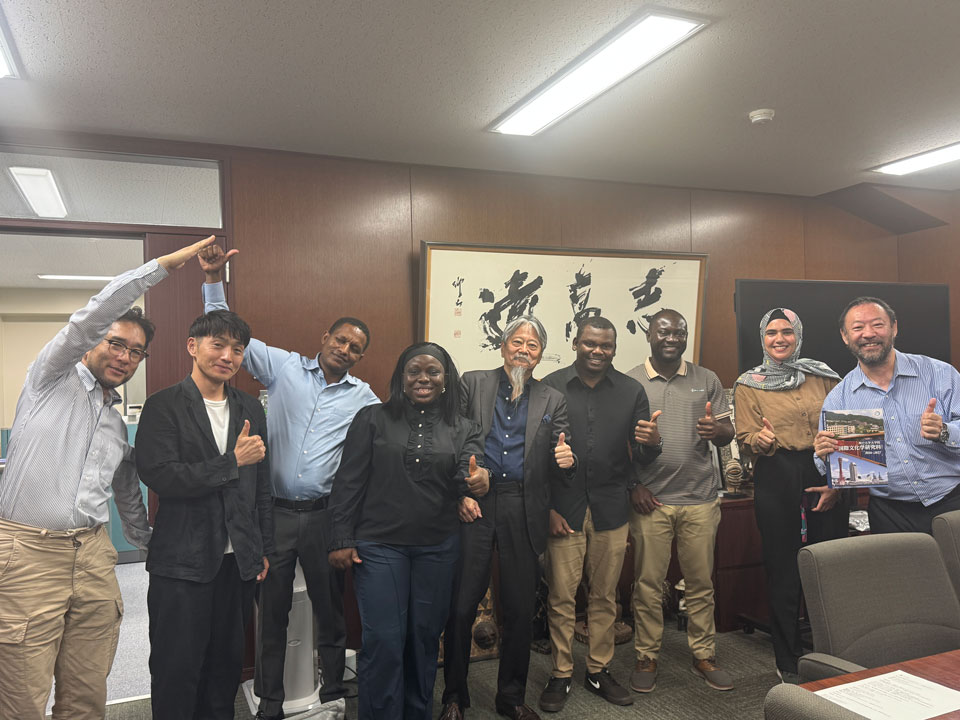
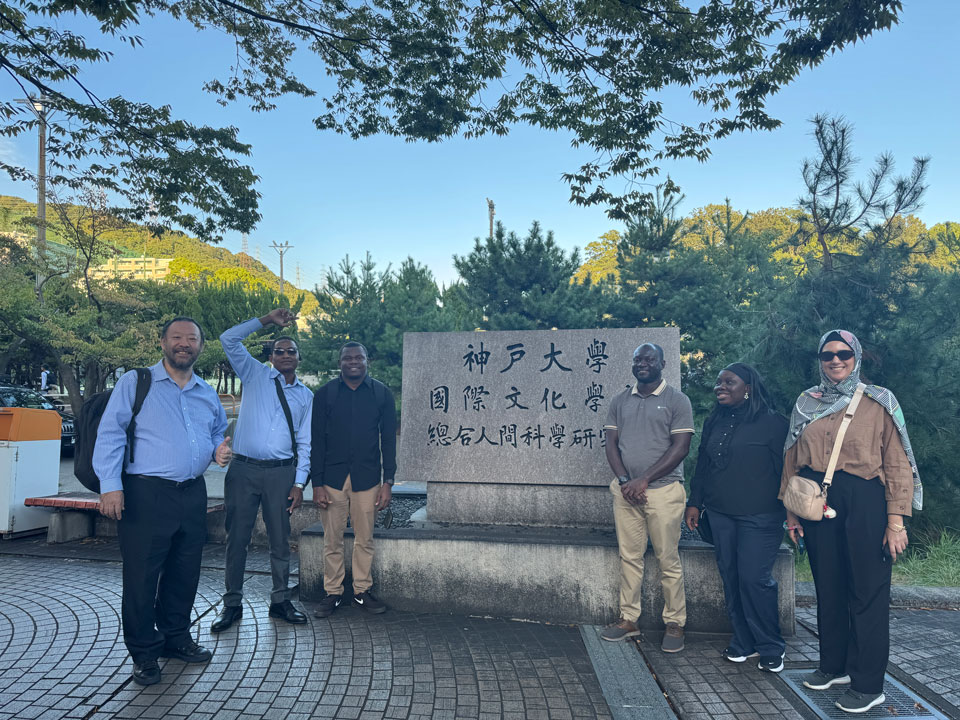
On October 2, 2026, I visited Kobe University’s Graduate School of Intercultural Studies with five interns from Scaleout. We met with Professor Kiyoshi Umeya, Dean of the Graduate School, Associate Professor Masato Karashima, and Project Assistant Professor Yushi Yanohara.
Professor Karashima, who arranged the meeting, specializes in the relationship between economics and culture, including international exchange and tourism.
Joining me were Enas (Egypt), Ghanney (Ghana), Takie (Ethiopia), Temi (Nigeria), and Amour (Tanzania). I studied in a different department, but Kobe University is still my alma mater. This time, I was back with the people I work with today. Familiar surroundings, but a whole new experience.
At Scaleout, we are exploring ideas to make travel and cultural exchange in Africa more accessible. Those ideas provided the starting point for our discussion.
Spells at a Football Match
Professor Umeya is a researcher and educator who has long been a leading figure in African studies. He has lived among communities in Uganda, studying witchcraft and other aspects of their cultures and everyday lives. One of the many subjects he discussed was cheering at football matches.
Professor Umeya told us that some supporters of African football teams chant spells hoping the opposing team will lose, rather than praying for their own side to win.
Unlike shouts of “Come on!” or “Score!”, these spells are directed at the opposing team. The desired victory is the same, but do you wish for your own team’s success, or try to bring about the opponent’s defeat?
The Japanese expression “ashi o hipparu”, roughly “dragging someone down'” comes to mind. It sounds a little unsportsmanlike. Yet choosing that phrase already brings our own values into the picture. What words do people chant? What do they expect to happen? It is too soon to wrap things up with “That’s a cultural difference.”
After the visit, Ghanney added, “Even in my own country, though, witchcraft is practiced by only a very small minority.” Takie was interested in how stories like this, and other lesser-known aspects of cultures across Africa, could be shared more widely.
It is certainly an intriguing story. But it would be a shame to let its novelty define our picture of Africa. The interesting part lies beyond that.
A Different Direction for the Same Wish
We also showed the professors the music video for “Get Well”, produced through Global Harmony Way. The song brings together voices and performances from different places, with 43 participants from around the world, including Ghanney, who joined us on the visit.
Let’s have fun together when you get well.
Could this feeling be shared across countries and cultures? With that in mind, I kept the song simple and easy to understand. The voices, though, are varied: low voices, husky voices, improvised scat. Each listener may picture a different face, too. A shared wish, sung in different voices. What mattered to me was how they resonated together.
More Enjoyment. Fewer Problems
What I sensed in Professor Umeya’s account, meanwhile, was the intensity of the wish. Not simply hoping your team will win, or the other team will lose, but trying to influence the result through a spell.
Simply wishing would not do. That was the urgency I sensed.
Borrowing that idea for Get Well, I would direct my efforts not at a person but at the problems causing them distress: illness, loneliness and the constraints of everyday life. Alongside “Let’s have fun together”, I would also ask what prevents that from happening.
Increasing the enjoyment we want, and reducing the difficulties we face. In business terms, these are close to what we call “gains” and “pains”. The spells we heard about could also be seen as an attempt to address a “pain point”: acting on what those chanting perceive as an obstacle.
In systems development, we would be talking about fixing bugs. Not just encouraging the person struggling with a malfunction, but addressing its cause. Of course, spells and code fixes differ in both what they address and how they do it. What I want to borrow is not the method itself, but the idea of changing where we direct our efforts.
Suppose someone wants to sing with us but struggles with the recording process. Rather than simply repeating “Please join in”, we could simplify the steps or rethink the tools. A song can make people want to participate; a better process can make participation possible. That is the kind of combination I have in mind.
We’ve moved from music to something a little more practical. But both are part of what we do.
Putting a wish into a song is also a way to express, through art, a vision of what we want to realize. Then there is the work of identifying what stands in its way and taking steps to address it. Different approaches, the same goal. Art, culture, technology, business. There may be many more possibilities in how we bring them together.
Shared Taxis and Hip-Hop
Professor Yanohara‘s research ranges from hip-hop in Cameroon to the music of communities in tropical forest regions. We also heard about his involvement in a project to “create a Cameroonian forest”. For those of us who make music, this is intriguing too.
That day, Professor Yanohara also told us about a theft tactic involving shared taxis in Cameroon. A crowd boards at once, rocking the vehicle and creating confusion. In the commotion, passengers can become targets of theft.
“Be careful” does not tell you how to be careful. Hearing specific accounts can help us identify what to watch for and what to check before setting off.
In her reflections after the visit, Enas stressed the need to take differences between countries into account. An experience in one place cannot simply be carried over to another, and the right person to ask may differ too.
What matters is not just collecting information, but being able to ask someone who knows the area, “Does that apply here too?” Such exchanges can also help us travel with greater peace of mind.
Amour and Temi, meanwhile, were interested in opportunities for Japanese students to visit Africa and learn there. The idea need not be limited to students. We might listen to local hip-hop, for instance, and ask the artists about its background. Those conversations can become part of the journey itself.
Some stories are worth hearing before a trip; others are worth traveling to hear firsthand. When we can picture not only a destination but also someone to talk to there, the journey comes into clearer focus. We want to value those human connections as we develop the ideas we are exploring.
The Story Continues—in a Thick Book
“There aren’t many copies of this left.”
With those words, Professor Umeya gave us a book bringing together his research on witchcraft.
And it is a thick book.
In conversation, “witchcraft” is just one word. Now I was holding an entire book devoted to understanding it. The time spent living alongside people, listening and thinking seems almost tangible in the thickness of the volume.
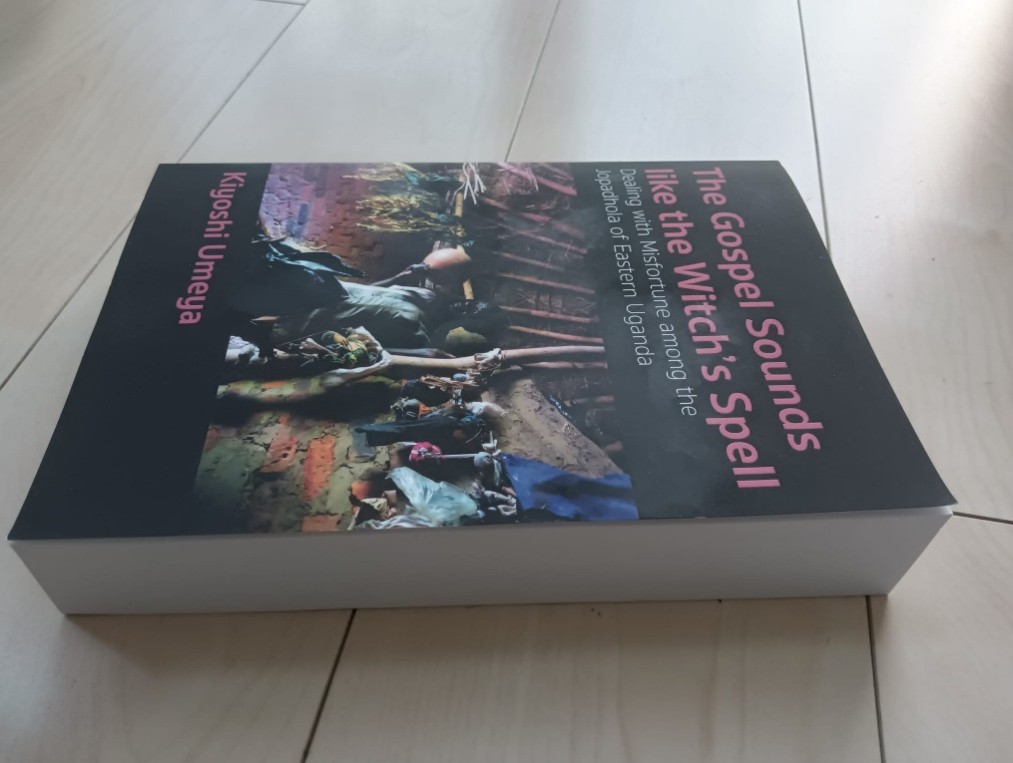
The title is The Gospel Sounds like the Witch’s Spell, the English edition of his Japanese book Fukuin o Toku Witch (福音を説くウィッチ).
The gospel, sounding like a witch’s spell.
Here, “gospel” means the Christian message of good news. The word also gives gospel music its name. Words that proclaim the gospel, and spells. What, exactly, sounds alike, and in what sense? There is plenty to wonder about in that title.
Still, with a book this substantial, I won’t promise a quick cover-to-cover read. I would like to return to it from time to time, following the questions that interest me.
According to the publisher’s description, the book follows how people in eastern Uganda understand, explain and respond to misfortunes such as illness and death. What do they see as the problem, and what kinds of power do they turn to? Behind those questions, there must be lives and relationships we cannot understand through imagination alone.
Questioning the Wish Itself—Once Again
If music is a medium for conveying our hopes, this visit added another perspective: acting on what prevents those hopes from being realized. The song itself stays the same, but our thinking about what comes next changes.
Here I find myself returning to the football spells. Wanting to change a match’s outcome badly enough to chant a spell. There is something distinctly human about that urgency.
That sense of urgency also made me think about AI. AI can work toward a goal, but could it itself feel an urgent desire: “I really want to change this situation”? Does it have a conscious will of its own, or could it develop one in the future? Researchers continue to debate these questions.
We can draw on AI to organize information and explore ways to put ideas into practice. But what do we truly want to achieve? AI may help us think through that question, too. At the same time, encounters with other people and new experiences can also give rise to new hopes/questions or reshape existing ones. This visit was just such an occasion.
Encounters with art and culture can change the questions we ask about technology and business. This time, for me, a conversation about witchcraft was the catalyst. This book may hold questions I have not yet thought to ask.
My thanks to Professor Umeya for sharing his firsthand knowledge and a treasured copy of his book, to Professor Karashima for arranging our meeting, and to Professor Yanohara for his insights into music and local life. Thank you all for such an engaging conversation.
And thank you to the five team members who joined me. The experiences and perspectives you brought helped me notice things I would have missed on my own.
My thanks also to everyone at JICA who supports us in hosting these internships.
The visit is captured in these photographs. What we took away extends well beyond the frame.
By Oggy | Scaleout Inc.