
Understanding AI and LLM Safety: Why It Matters for Users, Developers, and Society
02-05-2026
Introduction
As artificial intelligence becomes deeply embedded in how people learn, work, and communicate, the design, behavior, and impact of AI systems demand deliberate attention. Large Language Models (LLMs) now shape public knowledge, business strategy, education, and social dialogue. With this growing influence comes an urgent need to ensure these systems are trustworthy, ethical, and well-governed.
This article builds on our initiative on peace, which emphasized the role of technology in fostering peace, accountability, and shared global responsibility. History shows that technological progress can either strengthen societies or deepen harm. Today’s AI systems are no exception and must be guided carefully to support stability rather than risk.
These discussions were echoed at the 2025 Hiroshima Business Forum for Global Peace, held from 30 to 31 May 2025. Policymakers, business leaders, technologists, and so on, gathered to explore the ethical use of AI, highlighting human-centered values, risk awareness, and responsible innovation. Against this backdrop, understanding LLM safety becomes increasingly important.
What is LLM safety?
LLM safety refers to the technical, ethical, and governance measures that ensure language models behave in reliable and responsible ways. Its purpose is to reduce the risk of harmful, misleading, biased, or unsafe outputs while promoting:
- Accuracy and reliability
- Fairness and reduced bias
- Protection of user privacy
- Alignment with human values and ethical standards
In today’s AI-driven landscape, a growing number of LLMs are being developed by universities and technology companies around the world, with prominent examples including ChatGPT, Claude, Gemini, Cohere Command, and Mistral Large. As their usage expands, so do critical questions: Can their outputs be trusted? Is it safe to put sensitive information in LLMs? How dependable are AI-generated responses in high-stakes situations?
Taken together, these questions point to the real-world implications of LLM safety and the risks that emerge when model limitations are overlooked.
Why Blind Trust in LLMs Is Risky?
LLMs are increasingly used in areas where mistakes can cause real-world harm. However, many users lack the expertise to critically assess AI-generated information. Relying on these systems without caution can result in misinformation, ethical and legal issues, privacy violations, and flawed decision-making.
Key risks include:
- Hallucinations: Models may confidently generate false information, posing serious risks in academic, medical, or legal contexts.
- Harmful Content: Without safeguards, LLMs can produce abusive, violent, or illegal content, especially affecting vulnerable users e.g., children.
- Bias and Discrimination: Trained on human data, models can reflect and reinforce societal biases if not properly addressed.
- Privacy Concerns: Sensitive or personal information may unintentionally surface from training data.
- Over-Reliance: Treating AI outputs as absolute truth can lead to poor judgment, plagiarism, and unchecked error propagation.
- Security Exploits: Jailbreaks and prompt attacks can bypass safeguards, enabling misuse of AI systems.
Japan’s Approach to Safer and Sovereign LLMs
Japan has taken a proactive stance on AI safety by prioritizing transparency, cultural alignment, and national governance. Through a symposium organized by the National Institute of Informatics (NII) under the Ministry of Education, Culture, Sports, Science and Technology (MEXT), Japan has advanced dialogue on responsible LLM development.
Central to this effort is NII’s LLM study group and its open-source models (LLM-jp), a national initiative designed to reflect Japan’s language, cultural context, and legal framework. With continuous revisions and updates, early evaluations show performance comparable to leading global models, with stronger alignment to domestic values.
This strategy demonstrates Japan’s commitment to accountable AI through collaboration between researchers, policymakers, and industry. Rather than relying solely on foreign, English-centric systems, Japan is building locally governed AI that strengthens public trust.
Six interns from Scaleout attended the Japanese Symposium on Open Large Language Models in November 2025 in Tokyo, gaining direct insight into these efforts. Highlights included open evaluation tools for Japanese models, safety-focused datasets, improved multimodal reasoning, and specialized models addressing child safety and high-risk content. These initiatives address a major global gap: the need for culturally aware AI safety frameworks.
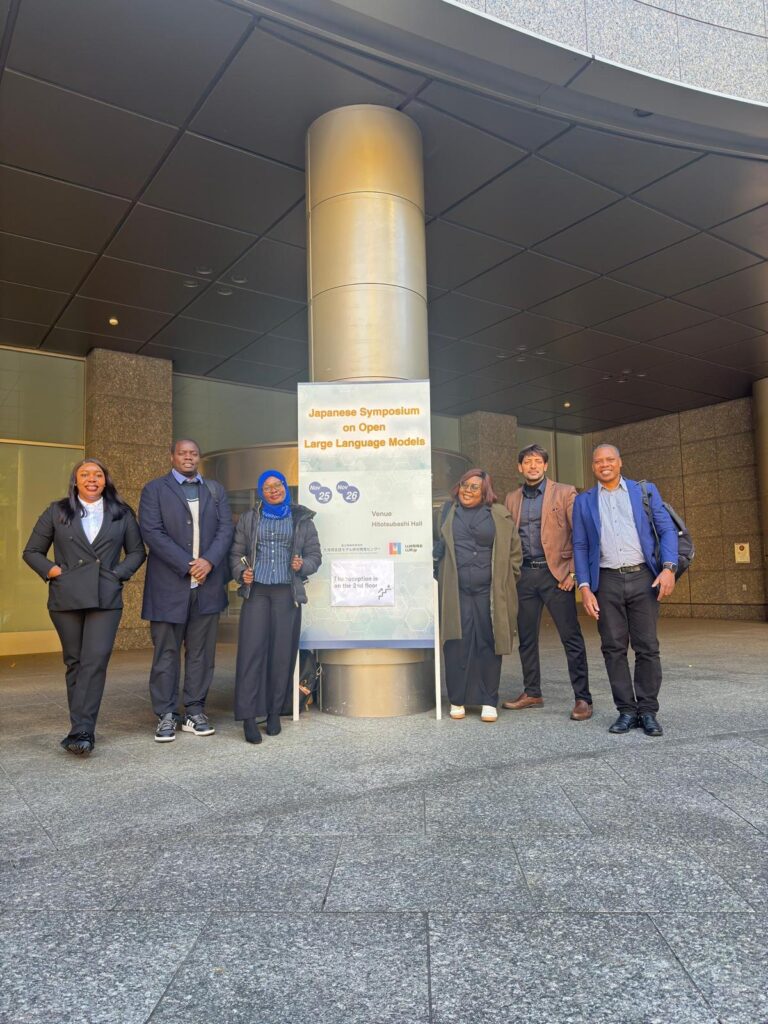
Scaleout Team at the symposium (from left to right): Dorothy – Crop Protection Expert (Nigeria); Ruyonga – Software Engineer (Uganda); Fetty (author) – Energy/Data Science (Tanzania); Chipo – Mathematics/Energy (Zambia); Ahmed – Petroleum Engineer (Egypt); and Emmanuel – Information Systems & Blockchain Expert (Uganda).
Conclusion: Safety as the Foundation for Responsible Technology
Although Scaleout is a member of LLM-jp but not directly involved in the model development, it is currently developing an AI-powered travel application called AfroGo (https://scaleout.tv/afrogo). AfroGo is intentionally centered on African countries, offering international travelers trusted destination insights, itinerary planning, and booking guidance to enable confident and informed travel decisions. As the platform evolves, Scaleout Inc intends to incorporate LLM safety measures to help ensure travelers access reliable information and to mitigate potential risks associated with LLM use.
This real-world use case highlights a broader reality: as AI increasingly shapes how people access information and make decisions, its expanding influence also heightens the risks of misinformation, bias, privacy exposure, and misuse. Addressing these challenges requires more than technical fixes.
For users, recognizing the limits of AI encourages critical engagement rather than unquestioned reliance. For developers and policymakers, these considerations must be integrated from design through deployment. When approached with care and intention, AI can evolve into a powerful tool that supports informed decision-making, social progress, and a more peaceful global future.
Written by: Fathia Jombi Kheir (Fetty)
Bless you!